About cowardice and conviction, the complicity of conservative elites, and the permission structure that governs the Right
By Thomas Zimmer, July 26, 2026
A note before we get started: My apologies for the lighter publication schedule in July as I am (supposed to be) on vacation with my family. I promise I will be back to a more regular and more frequent schedule soon (and let me also tease a bunch of new ideas and formats I’d like to add in the fall, as Democracy Americana nears its first birthday!).
Only the extended intro to this piece is free for everyone. If you want to read more than the preview, please consider becoming a paid member of Democracy Americana, which is solely funded by readers and constitutes my main source of income.
Being an independent writer offers a lot of autonomy, which is a privilege. But it is also precarious and comes with lots of financial uncertainty. If you can become a paid member, please do.
As a paid member, you also gain access to the audio version of the essay – which you can find at the end of the piece or available for download in the podcast player of your choice.
Without your support, I will not be able to continue this work. Please know that I am immensely grateful for your generosity!
Not ready yet for a paid membership? You can subscribe to the free version of the newsletter:
Donald Trump is outlasting the Republican establishment: The people who thought they could control him, harness the “populist” energies he was mobilizing for their own purposes; those who initially vowed to resist his temptation, but then quickly acquiesced; the people who constantly debased himself in his service and their quest for domination.
It has occurred to me that my life choices may not have been ideal if I am thinking about Lindsay Graham and Mitch McConnell while sitting on a beach during a family vacation at the Atlantic Ocean. Alas, here we are, and I will admit that Graham’s story, in particular, continues to have an effect on me. Not that I am mourning the man who should be remembered as one of Trump’s most willing enablers. Not that his case was so exceptional, in the grand scheme of things - even though few people disgraced and humiliated themselves quite as much as quite as often as Graham did in his struggle to be Donald Trump’s friend. The reason why it is worth dwelling on the last decade of Graham’s life is that it captured the core dynamics that have defined the behavior of the Republican establishment more broadly. His trajectory was precisely that of conservative elites in general: Faced with an insurgency from far-right extremists, they may have initially signaled distance and skepticism. But once it became clear that the base was enthralled with Trump, they quickly fell in line – and in the process made a mockery of every stated principle they ever claimed to follow.
Senator Lindsay Graham from South Carolina passed away on July 11, aged 71. In December 2015, when Donald Trump first rose within the GOP, Graham vowed to stand against the man he called “a race-baiting, xenophobic, religious bigot” in a CNN interview (Opens in a new window). In May 2016, when Trump was already certain to emerge from the GOP primaries as the Republican presidential nominee, he infamously posted on Ex-Twitter (Opens in a new window): “If we nominate Trump, we will get destroyed … and we will deserve it.” That tweet, remarkably, is still up. But even though his public comments suggested Graham understood who Trump was and what he represented, he quickly became a staunch defender of the MAGA president during his first term – constantly praising him and fighting for his agenda. Then January 6 happened and Graham once again seemed to change course. The night of the Insurrection, he declared on the Senate floor (Opens in a new window): “Trump and I, we had a hell of a journey. I hate it being this way. Oh my God I hate it … All I can say is count me out. Enough is enough.”
Alas, it wasn’t enough for Lindsay Graham. Just as the rest of his party quickly closed ranks behind Trump once the initial shock of the assault on the Capitol faded, Graham returned to doing whatever he could to be in Trump’s good graces.
What is there left to say about the rather pathetic case of Lindsay Graham? About his trajectory and that of his fellow Republican elites?
It has been a little over two weeks since he passed away, and I know a lot of people have weighed in. You know how we roll here at Democracy Americana (especially while I am nominally on vacation…): This is not the place for immediate commentary. It is unlikely I will ever be among the quickest to offer my take. But I believe there is value in letting the dust settle a little bit and then go deeper.
This piece is about Lindsay Graham and, more importantly, about the broader questions his case rases: About the trajectory of the Republican Party and the conditions that made Trump’s rise possible; about what made Trump attractive to conservative elites and why they are sticking with him; about the relationship between opportunism and ideology, cowardice and reactionary conviction; about the logic of escalation that is fueled by a sense of having burned all bridges; and, ultimately, about the permission structure that has governed rightwing politics for decades.
Unless we understand that, we understand nothing. Not how the Republican Party got to this point. And not where it is most likely going next.
What is there to be explained?
Allow me to start by anticipating a critique this piece is almost certain to garner: That I am “overcomplicating” things. Since Graham’s passing, two opposing tales have formed that are mirror images of each other, but are both built on the premise that there is no need for elaborate explanations at all. According to one, Graham and people like him quickly abandoned their principles as Trump took over the party because they are a bunch of careerists and cowards; or perhaps they never had any principles to begin with – either way, their trajectory is easily explained by opportunism. According to the other, there was no trajectory at all: Graham and his fellow Republican elites had always been exactly what they have revealed themselves to be as soon as Trump allowed them to indulge their reactionary authoritarian core – nothing has changed, only the masks have slipped.
Both of these tales offer crucial elements to what I believe is the actual story here. However, they require synthesis. The most plausible interpretation doesn’t necessarily lie exactly in the middle. But the challenge is to grapple seriously with how opportunism, cowardice, and careerism on one side vs. ideology and reactionary conviction on the other overlap and intersect. Only then can we hope to properly understand the motivations of people in positions of power who had tremendous influence over the trajectory of the Republican Party, how they justified making common cause with Trump. Only then will it be clear why we should assume they will continue to find ways to allow themselves to fuel, elevate, and enable extremism.
Republicans are not simply cowards. It’s worse.
Until Trump came along, Lindsay Graham was a “normal” Republican in the sense that he was recognizable as belonging to a well-established camp of elite conservative politicians: He was an arch-interventionist, close to neo-conservative circles on many foreign policy issues, and never met a foreign war he didn’t enthusiastically embrace. He was also known for having lots of friendly relationships across party lines and was willing to cooperate with Democrats on immigration reform or climate change issues. As the political scientist Seth Masket has documented (Opens in a new window), Lindsay Graham was more often censored by local GOP chapters than anyone else – mostly for working with the other side.
Graham was, in other words, very much part of the Republican mainstream and in fact liked to present himself as someone who could get along with everyone, regardless of party; a decade ago, he was certainly not part of any far-right insurgency within the GOP.
What happened?
A popular assumption is that Congressional Republicans like Graham are, more than anything, cowards who didn’t have it in them to stand up to the big bad bully Trump, fearing his wrath and that of his supporters. In Graham’s case more specifically, people seem to enjoy indulging in rumors that he was compromised somehow, that someone – Trump? The Russians? – must have compromising information and using it to blackmail him. I don’t find such speculation interesting or helpful. It’s entirely unnecessary to explain why Graham has acted exactly like hundreds of other Republicans in Congress and thousands of conservative elites across the country.
As for the cowardice narrative: I don’t want to deny that personal fear – fear that is justified considering MAGA America’s open embrace of militancy and fascistic violence – has played a role in individual cases. But as an overall explanation, the narrative that Republicans are just scared and cowardly is highly problematic. Let’s pay attention to the exculpatory implications that make the “lack of courage” tale so attractive, and not just for people on the Right. To Republicans, it provides cover: It may not be ideal, but it’s still better to be regarded a coward than an extremist. The doors to polite society will always be open to cowards – as soon as they show the slightest hint of a spine, they can even expect to be celebrated as heroes and role models. For the news media, the cowardice tale provides justification for clinging to the notion that underneath all the MAGA madness, the “normal” GOP still exists – it’s just struggling with an authoritarian insurrection, with a hostile takeover engineered by a few extremists who don’t represent the party’s true nature. Liberals, finally, may find comfort in the idea that everyone is committed to democracy, that deep down, we really all want the same thing for the country, even when some are just too scared of the mean demagogue and his cult followers to act on their beliefs. Such an approach is completely oblivious to – or deliberately tries to obscure – the fact that no such consensus exists, that there is no fundamental agreement on which to build. It is entirely misleading because it negates the actual nature of the conflict and what is at stake. And by conveniently ignoring the longstanding anti-democratic tendencies on the Right, we can tell a story that begins (and possibly ends!) with Trump.
Searching for a demagogue to mobilize the base
One important dimension the cowardice narrative completely ignores is that Republican elites have been searching for someone like Trump for decades. More precisely, they have indulged a style of politics and a political culture that served as fertile ground for Trumpism’s rise. I am not merely talking about the long-standing anti-democratic tendencies on the Right and the ways in which the GOP has morphed into the parliamentary arm of a much broader anti-pluralistic countermobilization since the middle decades of the twentieth century (something I wrote about at length here (Opens in a new window)). I am specifically referring to a deliberate choice, repeatedly made in the Republican halls of power, to embrace an aggressive culture war politics in order to mobilize the base by fueling racial and cultural resentment.
Already in the early 1970s, President Richard Nixon, who was not himself a movement conservative and who conservatives regarded with suspicion, pursued a so-called “southern strategy,” aiming to mobilize majorities by appealing to the racial and cultural resentments of white voters. If the electorate was sufficiently “polarized” along those lines, Nixon and his advisers were certain, the larger share of the voting public would opt to let their unease with the demographic and cultural pluralization of the country determine their political allegiances.
By the early 1990s, the Republican Party had become a recognizably conservative force on an accelerating rightward trajectory, as the conservative movement had managed to define the GOP’s agenda and identity. The party’s establishment seemed exhausted. The majority of the electorate had bought into Reaganism in the 80s. But instead of wealth and triumph, it had brought societal and economic devastation. At the end of the Cold War, a sense of crisis and frustration pervaded the nation and the party that had been in control of the White House for three consecutive terms. All the energy within the GOP was on the more radical Right. Its center of gravity was shifting rapidly away from the mainstream of American society on many key political, social, and cultural issues. Spurred on by the Religious Right, for instance, it was adopting the position of militant anti-abortion activists; the GOP was also embracing a reflexive anti-environmentalism as a key part of its political identity – climate change denialism became a pervasive posture among Republican elected officials.
Against this background, ethno-nationalist forces inside the Republican Party believed their time had come to stage a revolt against the GOP establishment. Uniting behind Pat Buchanan as their standard bearer, they challenged incumbent President George H. W. Bush in the 1992 Republican primaries. Buchanan openly professed an aggressive nationalism and explicitly embraced a vision of white Christian domination. And he was instrumental in shifting the Right’s focus more explicitly to what came to be called the “culture wars.” In his infamous speech at the 1992 Republican National Convention (Opens in a new window), Buchanan raged against “unrestricted abortion on demand,” “radical feminism,” “the amoral idea that gay and lesbian couples should have the same standing in law as married men and women,” “discrimination against religious schools,” “women in combat,” “environmental extremists,” “the raw sewage of pornography that pollutes our popular culture.” America was indeed changing, Buchanan warned: “But it is not the kind of change America wants. It is not the kind of change America needs. And it is not the kind of change we can tolerate in a nation that we still call God’s country.” Buchanan pleaded with his fellow Republicans to understand that “this election is about much more than who gets what. It is about who we are. It is about what we believe. It is about what we stand for as Americans. There is a religious war going on in our country for the soul of America. It is a cultural war, as critical to the kind of nation we will one day be as was the Cold War itself.
The paleo-charge came too early in 1992 and failed to dislodge the establishment. But Buchanan’s radical revolt, which had been met with a lot of support on the Republican base, had a lasting impact. A new generation of Republican politicians believed to have found the model for the future of rightwing politics. Newt Gingrich, who led the GOP in the House of Representatives, embodied this much more aggressive style of politics that took inspiration from the paleo-conservative insurgency. Gingrich demanded his party go all in on the culture war, all the time – and treat the Democratic Party no longer merely as a political opponent, bus as a fundamentally un-American enemy.
For decades, Republican elites have clung to the idea that they would be able to control the extremist, far-right popular energies on the base they kept stirring, harness them for their own purposes. Asked why he was already back to aligning behind Trump just weeks after January 6, Lindsay Graham said in March 2021 (Opens in a new window): “There’s something about Trump. There’s a dark side and there’s some magic there, and what I’m trying to do is just harness the magic.”
We are now decades into Republican elites attempting to “harness the magic” and control it, use it to their own ends. It has never worked – and instead turned the GOP into an instrument for the extremists.
Opportunism and ideology
Why not stop there: A story of opportunism, a cynical power play that got out of hand? Because we still need to examine why generations of Republican elites believed this gamble, if that is the right word, was a legitimate option. We should seek to understand why they believed their actions were justified.
It’s not plausible that anyone would get up in the morning and say: “I’m just a power-hungry servant of plutocratic elites.” Purely from a psychological standpoint, it’s unlikely for people to conceptualize their own behavior in such negative terms as opportunism, grift, and cynicism. While it’s become something of a storytelling cliché, the assumption that everyone is a hero in their own story remains valid.
There must therefore be an ideological dimension present - a specific worldview that shapes, frames, justifies, and allows people to make sense of their (inter-)actions. I try to think of opportunism and conviction not as mutually exclusive opposites, but as ideology circumscribing and defining the realm of opportunity. Let’s think of it this way: Had Lindsay Graham been strongly committed to the idea of multiracial democracy and to a vision of a society built around the principle of equality rather than hierarchies, making common cause with Trump in order to mobilize the base would not have been an option.
To say there’s more at play here than just “He lusts for power” is not to argue there must be something more honorable to be discovered. I’m not trying to “give Graham credit.” I’m trying to take seriously the fact that all humans have to make sense of their actions. This process of making sense of the world we experience, of our place and our choices in it, is not a question of intelligence or morals – it’s a necessity of the human condition.
It is precisely the combination of deeply held ideological convictions and the cynical opportunism with which these beliefs are enforced and put into practice, ideology and opportunism reinforcing each other in specific ways, that has made someone like Mitch McConnell so ruthlessly effective, for instance.
At the core of the reactionary political project has always been the idea that the world works best if it is run by wealthy white men – and that the hierarchies of race, gender, religion, and wealth that have traditionally distributed power and status in American society must be upheld because they are manifestations of a “natural” order. Frankly, it should not be all that difficult to discern why such a program appeals to wealthy white elite men like Lindsay Graham and Mitch McConnell.
What was the foundational worldview of Lindsay Graham? I believe it was on full display during the Kavanaugh hearings in September 2018. In July 2018, Brett Kavanaugh was nominated by Donald Trump to succeed retiring justice Anthony Kennedy on the Supreme Court. During the Senate hearings in September, it was revealed to the public that psychology professor Christine Blasey Ford had credibly accused Kavanaugh of sexual assault in 1982, when they were both teenagers, in a letter she sent to senator Dianne Feinstein immediately upon Kavanaugh’s nomination. She was later joined by two more women who also accused Kavanaugh of sexual assault. Both Blasey Ford and Kavanaugh then testified in a public Senate hearing. Republicans in the Senate ultimately confirmed Kavanaugh by a vote of 50-48.
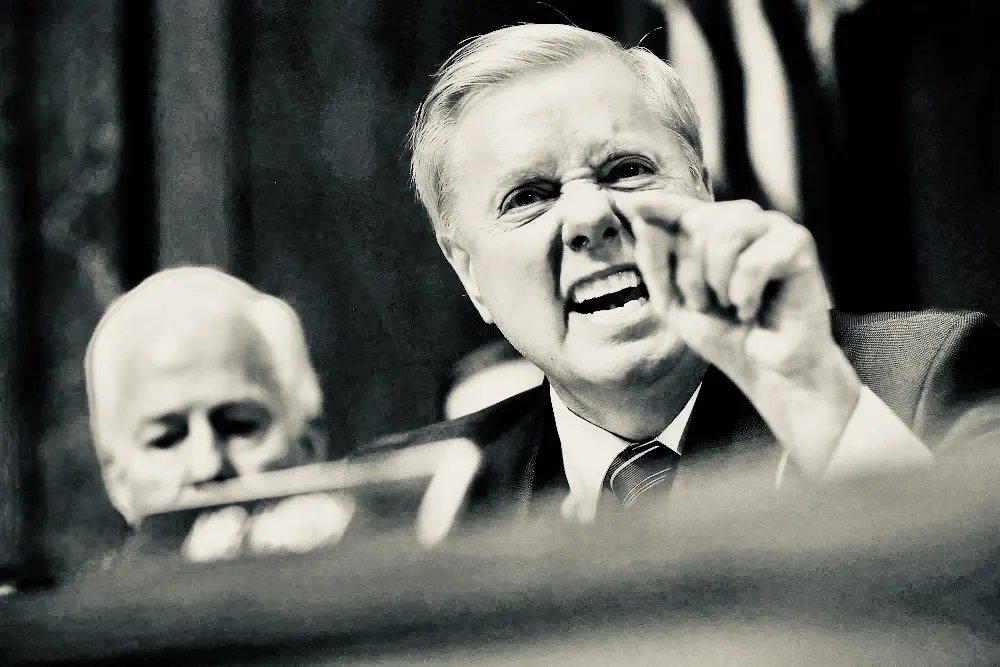
But for Lindsay Graham, this whole process was an outrage. During the hearings, Graham emerged as Kavanaugh’s staunchest defender. I urge everyone to look at the footage (Opens in a new window) from when the supposedly mild-mannered Graham raged against what he called the “most unethical sham” he had ever encountered in politics: Red-faced and sweaty, Graham told Kavanaugh how sorry he was that the nominee had been “through hell because of this crap”; he switched back and forth between fury for Senate Democrats and solidarity with Kavanaugh: “I cannot imagine what you and your family went through,” Graham said.
What Graham offered here was not an act. It was not just for show. This wasn’t just about pushing through a Supreme Court nominee – it wasn’t just about securing an immediate political victory. Graham was personally offended. He was shaken. That the ascendance of someone like Kavanaugh – a man who had spent his entire life in elite institutions among the wealthiest and most powerful in American society – was almost halted by the accusations of a woman… This was simply beyond what Graham was willing or able to tolerate. It was an assault on his most deeply held conviction: That a powerful white man must not be subjected to scrutiny and criticism, that it is the prerogative of wealthy white men to live in impunity. And that, more than anything else, is the promise of Trumpism as a political project: Look at me, Trump says, this is what you can have if you follow me, enable me, elevate me. Complete impunity, shamelessness, domination without restraint.
Why Republican elites stick with Trump
The fact that Donald Trump was able to put three justices on the Supreme Court and establish a 6-3 hard-right majority is a good reminder that conservative elites have gotten a lot out of the Trump experience. The same goes for Trump’s legislative agenda that mostly consists of a massive project to redistribute wealth upwards; and for the attempt to re-segregate the elite institutions of American life. It’s not “conservatism” in a colloquial sense of the word – but very much an implementation of the core project of the modern conservative movement: To entrench hierarchies of race, gender, religion, and wealth – and roll back whatever progress had been made over the past few decades towards leveling those hierarchies.
That is one crucial part of the answer to the question of why Republican elites have been sticking with him. Another is that after debasing themselves for so long as part of the bargain they struck with Trump, it becomes difficult to turn around. Over a decade into the Trump experience, we might as well ask: How could they not close ranks behind Trump, no matter what happens, after all they have accepted, supported, justified, and condoned so far? One key dynamic here seems to be that those who are still on Team Trump now have invested so much in terms of justifying their actions to themselves and to the world, and have thereby enabled such outlandish behavior, that it might be hard, even purely from a psychological standpoint, to imagine getting out still. If you leave now, was it all for nothing? All the times you had to embarrass yourself in public? And the people who you have painted as the radically “Un-American” enemy, those whose “witch hunt” you have decried for years, are you ultimately going to let them win?
A kind of negative bond has formed between the likes of Lindsay Graham and the leader they have chosen. Where else could they go but forward, with the regime? They have gone so far already with and for Trump, and in the process become complicit in his rise, his rule, his lawlessness, his breathtaking corruption. All the bridges have been burned.
Radicalization over restraint. Always.
And so, they stick with Trump – and have to find ever more extreme justifications for why he is, at worst, the lesser evil compared to the “leftist” enemy. That is partly why the Right is constantly playing up the threat of “woke” radicalism and the “illiberal Left.” That is why Trump and his allies are now raging against the supposed threat of “communism” in a bizarre attempt to thrust the country into a new red scare (Opens in a new window). “Communists everywhere!” – that is not an empirical assessment, but an ideological claim. It is political propaganda, of course, intended not to convince people but to set an agenda. And Republicans are joining in because we are nearing a Congressional election they are set to lose, yes; but also because these outlandish claims, from their perspective, must be true, on some level at least, as they provide the sole justification for everything the party has been doing for years.
It has become dogma on the Right to define “Us” (conservative white Christians) as the sole proponents of “real America” – and “Them” (Democrats, liberals, “the Left”) as a dangerous “Other.” The Democratic Party, in this understanding, is not just a political opponent, but an “Un-American” enemy – a fundamentally illegitimate political faction captured by the radical forces of leftism, liberalism, wokeism, and multiculturalism. The Right doesn’t see the struggle between Republicans and Democrats as a competition between political opponents – but as an existential conflict over whether or not the only version of the country they are willing to accept as “America” will survive and endure. Rightwingers have decided that they are the country. The choice, therefore, isn’t partisanship or loyalty to the country. To them, the partisan divide maps perfectly onto the struggle between patriots and “Un-American” radicals for the survival of the nation. In that sense, choosing Trump is choosing the country.
Within the confines of such a worldview, it’s hard to justify compromise and restraint – it constantly privileges the more radical over the more “moderate” forces within the Republican Party. Every crisis situation only heightens the sense of being under siege that’s animating so much of what is happening on the Right, legitimizing and amplifying calls to hit harder, more aggressively. There’s always permission to escalate, hardly ever to pull back.
This is the permission structure that governs conservative politics: Anything is justified in defense against what they constantly play up as a radically “Un-American,” extremist “Left” that has supposedly taken over the Democratic Party. As crass or radical or outrageous as some on the Right might find him and his actions, nothing Trump has ever done has betrayed the accepted dogma of conservative politics: That only white conservatives – and the party that represents them – are entitled to rule in America, that Democratic governance is inherently illegitimate, that the “leftist” enemy within is the greatest danger to the nation. It’s a permission structure that doesn’t allow for lines that can’t be crossed. It has proven remarkably adaptable, fully capable of handling the most outlandish transgressions and crimes. It has allowed them to justify their actions within the long-established framework of conservative self-victimization – and to present their allegiance to Trump as a patriotic act.
Do Republicans really believe this – or is this all just a cynical game? Yes, there is a good deal of opportunism and cynicism involved. And many on the Right don’t necessarily believe in the specifics of this conspiracy theory or that chimera of stolen elections. But they are still “true believers” – maybe not in Trump, the person, but in the political project Trumpism stands for: the white grievance politics that seeks to forever preserve America as a place of strict hierarchies of race, gender, religion, and wealth.
Today, even as Trump’s hold over the different factions of the MAGA movement is waning and the man himself is in steep physical and mental decline, that permission structure remains fully intact. Therefore, unless we see some hard evidence to the contrary, our default assumption should be that the forces of anti-“Leftism” (or anti-anti-Trumpism) will prevail among Republican elites. They won’t wake up one day having a “What have we done?” epiphany. Or even if they do, as was occasionally the case with Lindsay Graham, they’ll quickly ignore it and go right back to finding ways of giving themselves permission. They have gone so very far already with and for Trump. They will keep going.
Thank you for reading and thank you for listening – and please know that I am deeply grateful for your support and your generosity!
Date
July 26, 2026
6 comments
Would you like to see the comments?
Become a member of Democracy Americana to join the discussion.