Putting the end of the civil rights era in historical perspective: How it transformed the nation, how it was toppled by a raging reaction, and what comes next
By Thomas Zimmer, May 17, 2026
This is Part II of my history of multiracial democracy in America. In last week’s Part I, which you find here (Opens in a new window), I focused on the fate of the first attempt at biracial democracy after the Civil War, and on the political implications of the Reconstruction era for today.
In this Part II, I look at America’s Second Reconstruction that was codified in the civil rights legislation of the 1960s, reflect on why this had such a transformative impact on politics and society – and examine why this current moment really marks a profound cesura in U.S. history: The end of the civil rights era.
This is coming out a little later than I had hoped or anticipated – and for that, I want to apologize. But I really wanted to do this story justice. It is fitting, therefore, that this is by far the longest essay I have ever published on Democracy Americana. An attempt to really put into perspective what a profoundly important – and disturbing - moment in U.S. history we are currently witnessing.
Only the extended intro to this piece is free for everyone. If you want to read more than the preview or gain access to the audio version of the essay, please consider becoming a paid member of Democracy Americana, which is solely funded by readers and constitutes my main source of income as an independent writer.
Without your support, I will not be able to continue this work. Please know that I am immensely grateful for your generosity!
Not ready yet for a paid membership? You can subscribe to the free version of the newsletter:
It has been a horrifying, yet entirely predictable spectacle. Since the Supreme Court functionally nullified the 1965 Voting Rights Act on April 29, Republicans have rushed to gerrymander majority-minority districts out of existence. The euphoric zeal they are displaying while extinguishing Black political representation across the South reveals precisely what is going on here.
Finally, Bennie Thompson’s “reign of terror” (Opens in a new window) over Mississippi’s second congressional district was coming to an end, Mississippi Governor Tate Reeves declared on May 13. Thompson is the sole Black person and the only Democrat among the state’s congressional delegation. He has represented his majority-Black district in Congress since 1993, regularly receiving two thirds of the vote. But that doesn’t matter to Governor Reeves: Thompson’s “reign” is illegitimate because the people who vote for him don’t count, or they shouldn’t, and now that the Roberts Court has opened the door for that, Republicans in Mississippi will make sure they won’t.
In Alabama, Governor Kay Ivey celebrated (Opens in a new window) the chance to dilute and obliterate Black voting power because “Alabama knows our state, our people and our districts best,” and this “win for Alabamians,” as she put it, “enables our values to be best represented in Congress.” It is certainly not a “win” for the 27 percent of the population that are Black – but those simply don’t count among the “Alabamians” Ivey cares about. Two out of the state’s seven congressional districts are currently represented by Black Democratic lawmakers. That will now change. “Our state.” “Our people.” “Our values.” People of color not included.
“For too long,” Tennessee Representative Andy Ogles raged on May 7 (Opens in a new window), “Tennessee politics has been dominated by cosmopolitan communists and race hustlers imposing their corrupt will on a deeply rural and conservative state.” Tennessee is about 77 percent white and 17 percent Black. Eight out of its nine Congressional districts are represented by white Republicans. It is Tennessee’s ninth district that Ogles was enraged about, the one around Memphis: 60 percent of the population is Black, about 9 percent Hispanic. Kamala Harris received around 70 percent of the vote here in 2024. And over 70 percent sent Stephen Ira Cohen to Washington, a white Democratic progressive, the first Jewish person to represent Tennessee in Congress. That’s who Ogles refers to when he bemoans “cosmopolitan communists”; and the “race hustlers,” that’s just people of color. Their numbers are irrelevant; majorities built on their votes don’t count. And so they won’t: Republicans have already enacted a new map (Opens in a new window) that carves up the ninth district, distributing minorities across three districts in a way that leaves only white-dominated ones. One of the new districts stretches about 200 miles north-east all the way to the outskirts of Nashville: That’s how far they had to go to find enough white people to make sure Black voting power was sufficiently diluted.
None of this is subtle. None of it is new. And even the rhetoric has always been the same. White supremacists presented exactly these arguments to justify their struggle to undo Reconstruction after the Civil War: They were fighting against an evil imposition of Northern tyranny, against outsiders and intruders illegitimately put in charge of the South. Those who fought against de-segregation and civil rights in the 1950s and 60s made the same claims. In his inaugural address (Opens in a new window) as governor of Alabama in January 1963, George Wallace vowed to defend “segregation now, segregation tomorrow, and segregation forever” not because of racism, no! But to defend the “freedom” of the South and its true people. “Let us rise to the call of freedom-loving blood that is in us,” Wallace declared, “and send our answer to the tyranny that clanks its chains upon the South.” Yet again, just like after the Civil War, when “the South was set upon by the vulturous carpetbagger and federal troops,” it was time to take a stand and “sound the drum for freedom.” It is a particular kind of freedom, Wallace was concerned with – the same “freedom” Reeves, Ivey, and Ogles are defending now: The freedom of white people to dominate and rule, and to curtail the freedom of others.
The first task for observers, analysts, and citizens alike is to understand, acknowledge, and describe clearly and honestly what is happening around us. And here I will allow myself to write angry…
Angry about the endless attempts, even now, to obscure rather than illuminate what is right in front of us. Angry about a mainstream discourse that has somehow declared it uncouth, or not “sophisticated” enough, or too “divisive” to acknowledge that racism, patriarchal domination, and Christian supremacism are the animating forces on the Right, dominating today’s Republican Party. Angry at the tireless efforts by pundits and politicians to sanitize the discourse by coming up with ways to explain what is happening as something other than what it looks like; or at least declare all the “racial and cultural anxiety” as merely downstream from something else, from “economic anxiety” and “polarization,” perhaps. Angry at the fact that we are constantly asked to come up with exculpatory tales, to please not call those pursuing a political project of re-segregation racists or segregationists.
The proof is in the pudding. Wherever and whenever Republican lawmakers get the chance, they rush to make it harder for people of color to participate in the political process, to exercise their right to vote and have their vote actually count, all in service of rolling back the civil rights order and restoring unfettered white male Christian supremacy.
None of this is subtle. None of it is new. And yet, this is a crucial moment in that long struggle between those who want the country to finally realize its egalitarian promise and those who consider egalitarian democracy the destruction of “real America.” Only if we take a step back and situate what is unfolding around us in this long-term conflict can we grasp the historical significance of this dark moment.
Let us explore the civil rights revolution of the 1960s, reflect on why it had such a transformative impact on politics and society – and examine why what we are witnessing now really is best understood as the end of a distinct era in U.S. history: The end of the civil rights order, the downfall of America’s Second Reconstruction. We are now into the second white reactionary “Redemption.” Let’s make sure we really understand what that means.
When does an era end? And how can we tell?
In various public talks and interviews over the past two-and-a-half weeks, I have emphasized (as have many others) that the Robert Court’s decision in Louisiana v. Callais is an era-defining event, that we are witnessing the end of the civil rights era in U.S. history. The reactions I have gotten in response have ranged from shock and outrage to skepticism and downright incredulity. And I get it why it is difficult to grasp the significance of this moment. Amidst the constant Breaking News chaos of the Trump era, everything feels like a continuous emergency – why would this particular decision even stand out? Isn’t this just another crisis in a series of so many? Partially, I suspect, there is also an element of denial. To suggest that the civil rights era is over is a straight-up scary proposition. And I will also admit that it is inherently difficult to diagnose the historical significance of any event or development contemporaneously – which is why historians tend to wait and let quite a bit of time pass before they make such determinations retroactively. And yet, while acknowledging all those caveats, I feel justified in making that assessment now. If there are still human beings writing history books fifty or one hundred years from now and we haven’t completely lost our ability for intellectual and cultural production after decades of handing all cognitive operations over to some AI, I feel confident in predicting that those future books will describe this moment as a profound cesura in the long, contested history of democracy in America.
Perhaps it is useful to reflect a little bit on how we can tell if an era is over: How do historians judge if a distinct period in history is coming to an end?
Historians love to think about “periodization,” the process of distinguishing phases, delineating distinct eras in time and what characterized them, what differentiated them from what came before and after, and what qualifies as turning points separating them?
There is almost never an objectively correct answer to those questions, or at least not just one “truth.” Historical periods are retroactive constructs, not natural phenomena that we can identify and observe through experiments. Different questions will generate different periodizations: If you are interested in the history of the presidency, for instance, you will delineate periods and turning points that differ from those that have shaped America’s political economy or the nation’s history of political thought. And even within the same topic, the exact periodization is always up for debate, different suggestions might be equally plausible.
Why bother at all then? Because while diagnosing distinct periods in history is inherently an act of interpretation that is up for contestation, it is not a random act. Historians investigate change over time, with the goal of making sense of the world around us by situating the present in what we understand as “history.” In order to do that, our thinking about the past, about “history,” must avoid two common pitfalls. One is to assume that everything has always been connected to everything else: “History” dissolved into an eternal dark river of time. The other is to assume that “history” unfolds as a series of separate, unrelated events and contingencies without any meaningful connections. Such approaches lead nowhere. Thinking about “periodization” is clarifying because it forces us to reflect on continuity and change, traditions and new departures, and questions of causality.
Let’s bring this back to the matter at hand: Where do we stand in this long struggle over how much democracy, and for whom, there should be in America? This is such a complex history, and the scholarship is vast. Delineating distinct phases and identifying the key dynamics that characterize them can help us understand not just the past, but also the place of our current moment in that story.
Periodization is not primarily about finding exact start and end dates for different eras. What we are looking for, more often than not, is a date that can symbolize defining trends and tendencies – a moment that may exemplify that something significant has shifted. Take America’s first Reconstruction, for instance. The Reconstruction period is generally identified to have lasted from 1865 to 1877. However, its exact dates differed from region to region. Sometimes, Reconstruction started before the end of the war, when the Union Army conquered Confederate territory. In some places, whatever progress had been achieved was rolled back before 1877; in other places, the biracial experiment lasted into the 1880s, until the consolidation of Jim Crow apartheid. And yet, as long as we understand that broader story and context, those established dates still make sense. It was not until the end of the Civil War in 1865 that “reconstructing” the nation – or, rather: reconceptualizing it around the idea of equality – had any chance of becoming the defining project. Once it was clear that the federal government would no longer enforce Reconstruction under Rutherford B. Hayes as president, America’s first attempt at biracial democracy was doomed across the South. The year 1877 therefore marked such a profound shift in structural conditions that it makes sense to see it as a cesura.
The important thing is to remember that historical eras are never static. We delineate them by stipulating that for a certain period, we can identify key characteristics or dynamics. But there is always conflict, there are always crosscurrents and countervailing forces. There is always the struggle between forces who seek to entrench the status quo and those who desire to overcome it. Reconstruction sparked an immediate countermobilization in service of white supremacy that managed to become hegemonic at some point after 1877. But even as the reactionary entrenchment won in the late nineteenth century, the fight was not over. It took decades of work, with uncertain outcome, yet those who sought to overcome this regime of ruthless white domination ultimately achieved marvelous things: A Second Reconstruction, codified in the civil rights legislation of the 1960s that once again shifted the structural conditions for the democratic struggle in ways so significant that it undoubtedly constituted the beginning of a new era.
The 1960s civil rights revolution was a watershed moment
The crowning achievements of the mid-century civil rights struggle – the 1964 Civil Rights Act and the Voting Rights Act of 1965 – were directly tied to the post-Civil War Reconstruction amendments. The Civil Rights Act was fundamentally an attempt to finally enforce the 14th Amendment of 1868 that had established formal equality before the law and the principle of nondiscrimination. Previous Civil Rights Acts had brought more tentative improvements; but it wasn’t until the 1964 legislation that the playing field was properly changed – not just for Black Americans, but for every minority group. Crucially, it also enabled significant progress in the struggle against discrimination on the basis of sex and gender.
Similarly, the 1965 Voting Rights Act aimed at finally enforcing the 15th Amendment, ratified almost a century earlier in 1870, which had barred the federal government and the states from denying a citizen’s right to vote “on account of race, color, or previous condition of servitude.” The VRA’s two major provisions are often called the “sword” and the “shield.” Section 2, the sword, was supposed to strike down discriminatory laws or regulations. It allowed the federal government and private plaintiffs to bring lawsuits against such laws and regulations. After the Supreme Court initially attempted to impose a very narrow reading of the VRA that would have necessitated proving racially discriminatory intent (something that is practically almost impossible), Congress re-authorized and amended the VRA in 1982 and specified that discriminatory effects were actually enough.
Section 5 of the VRA, the shield, required jurisdictions with a history of racial discrimination to acquire pre-clearance from the federal government for any change in voting laws. Pre-clearance was a gamechanger, as it solved a key issue that had plagued all previous attempts to enforce the 15th Amendment: Until 1965, the federal government had only ever been able to target individual locations and cases. As a result, the enforcement of voting rights was never going to be able to keep up with the flood of rights violations; and every case cost time and money while discriminatory laws and regulations went into effect and had their intended consequences. The available remedy had simply not been commensurate with the problem.
Crucially, both the sword and the shield applied to vote denial (any attempt at making it harder to cast a vote) as well as vote dilution (schemes to weaken and dilute the impact of votes cast). Pre-clearance under Section 5 of the VRA blocked around 1,200 laws and regulations – most of them on the local level – before the Roberts Court gutted it in its decision in Shelby County v. Holder in 2013.
The civil rights legislation of the 1960s fundamentally changed the landscape, the structural conditions shaping the struggle to democratize America. It really was revolutionary in impact. It was fueled by an understanding that the inequalities of American life were not the manifestation of “natural” hierarchies or cultural pathologies in certain groups, but of discriminatory intent and structures. Here was an acknowledgment that this situation needed to be remedied by active countermeasures. Political, legal, and social structures needed to be dismantled and reformed, because they generated discriminatory outcomes not as an exception or unintended consequence, but because a nation built on racial and gender hierarchies had produced a system that perpetuated them. And for anything to change, the federal government – who else! – needed to take responsibility for enacting countermeasures.
In that way, the civil rights revolution also fundamentally reconfigured the relationship between the federal government and the states. It set the federal government up to act as the engine of democratization. It created a set of regulations as well as a legal and administrative machinery at the federal level to enforce the right to vote and Black civil rights, desegregate American life, and ban discrimination on the basis of gender or sexual orientation. All of this the federal government had to do in direct conflict with those states that were governed by reactionaries, segregationists, and proponents of white Christian patriarchal domination.
None of this is to say that the federal government has acted always and solely as a democratizing force since the 1960s. And it is crucial to remember that the impetus for these changes, and for the federal government to accept such a role at all, came from below. Effective civil rights legislation followed public pressure. And the pressure from mainstream white America was achieved by the tireless work and sacrifice from civil rights activists – and especially the Black freedom movement.
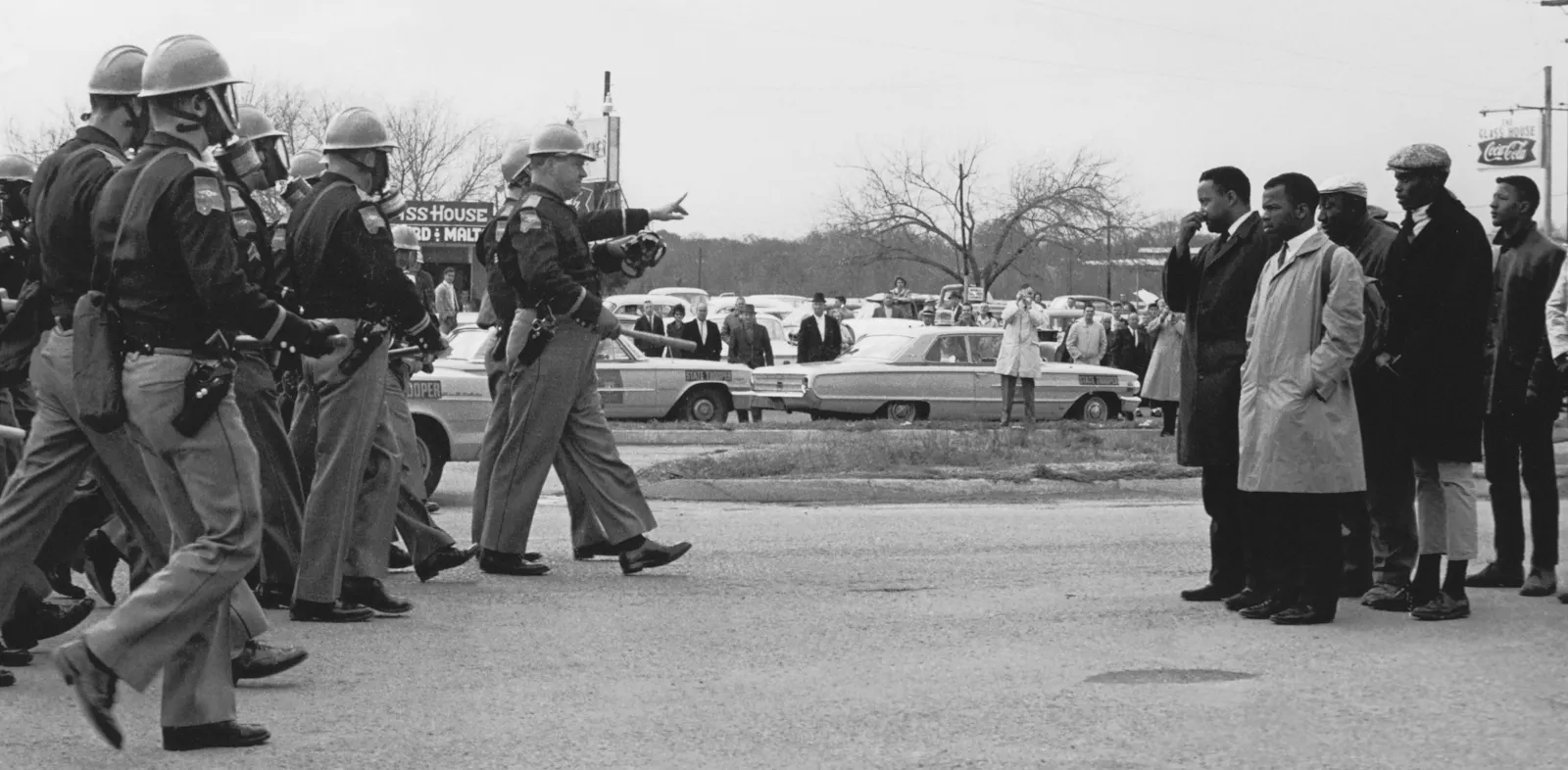
Nowhere is this dynamic more evident than in the genesis of the Voting Rights Act. It was the Selma to Montgomery marches of March 1965, themselves the culmination of many years of activism and sacrifice, that captured the attention and the imagination of the American public. On March 7, the peaceful, unarmed marchers were assaulted by state troopers and police once they crossed Edmund Pettus Bridge leaving Selma in the direction of Montgomery. Americans across the nation watched the footage from “Bloody Sunday” in horror, reminded or made to realize what the reality of racism and racial segregation looked like in practice: Innocent people beaten and brutalized by the agents of the state. The urgency of the situation had become undeniable, even in a country that had been built on racial subjugation. Finally, the public pressure on America’s elected officials was high enough to implement some proper changes.
The Voting Rights Act, signed into law less than half a year later, was the direct result. The VRA’s history is also a reminder, however, that in practice, any success at extending the promise of equality beyond white people depended on forceful enforcement through the state – on the federal government imposing it against the enemies of democracy. For instance, the VRA provided for federal election registrars to be sent as examiners to counties where racial discrimination could be proven. The record across the South is unambiguous: Counties where federal observers were present achieved a significantly higher percentage of Black voter registration than those where this immediate form of federal oversight was not available. “Black political rights,” Jefferson Cowie states in his masterful history (Opens in a new window) of the freedom struggle in Barbour County, Alabama, the home of George Wallace, “depended upon federal enforcement.”
The impact of the Voting Rights Act
On March 15, a week after Bloody Sunday in Selma, President Lyndon Johnson addressed a joint session of Congress and gave what is known as his “The American Promise” speech (Opens in a new window). “I speak tonight for the dignity of man and the destiny of democracy,” Johnson began. He was adamant that the civil rights struggle was not a matter of politics, but of morality, human rights, and national identity:
“Our lives have been marked with debate about great issues; issues of war and peace, issues of prosperity and depression. But rarely in any time does an issue lay bare the secret heart of America itself. Rarely are we met with a challenge, not to our growth or abundance, our welfare or our security, but rather to the values and the purposes and the meaning of our beloved Nation.”
After Selma, in that very moment, nothing else mattered:
“The issue of equal rights for American Negroes is such an issue. And should we defeat every enemy, should we double our wealth and conquer the stars, and still be unequal to this issue, then we will have failed as a people and as a nation.”
In what is probably the most famous passage from the speech, the president declared:
“There is no Negro problem. There is no Southern problem. There is no Northern problem. There is only an American problem. And we are met here tonight as Americans – not as Democrats or Republicans – we are met here as Americans to solve that problem.”
The Voting Rights Act was intended as the solution. As Johnson signed it on August 6, 1965, the president attempted to capture the historical significance (Opens in a new window) of the moment: “Today is a triumph for freedom as huge as any victory that has ever been won on any battlefield,” the president declared.
I wrote this in my previous piece, and I’ll write it again here: Before the Voting Rights Act of 1965, America was not a democracy. It was certainly not what we, in widely accepted parlance today, call “democracy.” It absolutely had no reasonable claim to be considered a multiracial democracy.
After the brief democratic experiment during Reconstruction, Black Americans were once again excluded from political participation in the South, subjugated to a brutal one-party apartheid state. Starting in the late 1880s, the Southern states rewrote their constitutions to ensure complete white domination. They passed voting laws that disenfranchised Black Americans via poll taxes, literacy tests, or property requirements. As a result, voter registration rates and Black turnout plummeted from around 80 percent shortly after the Civil War to somewhere in the zero to five percent range, where they would remain until at least the 1940s. Voter registration picked up a little bit, especially during and after the Second World War. But even by early 1965, only about one third of eligible Black Americans were registered in most states across the South; sometimes, as was the case in Alabama and Mississippi, the rate was vastly lower. The gap in voter registration rates between Blacks and whites tended to be around 30 percentage points at least.
During this period, Black political representation was extinguished. About 2,000 Black men had been elected to public office at the local, state, and federal levels during Reconstruction. But after 1881, the South did not elect another Black person to the Senate until 2013. After 1901, no Southern State sent any Black Representatives to the House until 72 years later.
The impact of the Voting Rights Act was immediate and comprehensive. By 1968, voter registration among African Americans had increased to about 60 percent across the South; in states that had employed literacy tests before the VRA it basically doubled immediately. The gap in voter registration (Opens in a new window) between Blacks and whites narrowed to under 10 percent by the early 1970s. The turnout-gap, which had been about 50 percentage points in the South in the mid-1950s, was practically eliminated (Opens in a new window). Once again, minority voters proved that if you extend the democratic promise to people, they will gladly and enthusiastically grasp the chance they are being offered.
One effect of this dramatic influx of previously disenfranchised voters was the return of actual political competition to the South. Segregationist Democrats may have been able to hold on to power in many places. But the time of unquestioned one-party rule was coming to an end.
Another effect was the explosion of minority political representation. Hundreds of Black people were elected to public office on the local, state, and federal level within just a few years after the VRA. In Congress (Opens in a new window), the development was rather slow. There had been just six Black Americans in the 89th Congress in 1965-66 (none from the South); ten years later, the number was up to 17. In the mid-1990s, there were over forty Black elected officials in Congress; and in recent years, the percentage of Black Representatives and Senators has been, finally, roughly proportionate to the percentage of Black people in the overall population.
Similar trends reshaped the political landscape on the state and local level (Opens in a new window). Before the VRA, there had been almost no Black representation on municipal councils, even in communities where between one third and half of the population was Black. After the Voting Rights Act, Black representation came to mirror the Black share of the population in these communities.
Increased political competition and Black representation led to different policy outcomes too. African Americans and other minorities were now a constituency that politicians had to reckon with; their needs and preferences needed to be factored in – and they finally had a fair chance to elect representatives of their choice who would make sure that these disadvantaged communities could no longer be fully discarded, ignored, and actively punished. As a result, counties and communities with a large Black population received a much larger share of public goods and state funding (Opens in a new window). Overall, Black economic power increased (Opens in a new window) as this kind of fiscal redistribution combined with improved employment opportunities especially in the public sector, due to anti-discrimination laws and affirmative action.
No one needs to pretend that the Voting Rights Act fixed everything, that it turned the United States into some perfectly fair democratic utopia. And the kind of descriptive representation (when the demographics of elected officials and thus the parliamentary chambers correspond to the demographic makeup of the electorate) the VRA enabled was obviously not some magic bullet that solved all problems. But there is no question that in 1964/65, the structural conditions under which the struggle for equality played out were significantly altered: The playing field became vastly more conducive to a truly democratic politics. With the Voting Rights Act, America finally turned into something that deserved to be considered a multiracial democracy – however flawed it certainly remained.
A raging reactionary countermobilization
Throughout U.S. history, democratic progress – any attempt at leveling existing hierarchies of race, gender, religion, and wealth – has inevitably led to a massive countermobilization orchestrated by the forces of reaction.
The democratizing achievements since the 1950s and 60s have not been manifestations of a broad societal consensus. They didn’t follow “organically” from successful efforts to persuade all but the fringe. They had to be imposed against massive reactionary resistance.
I think it is fair to say that those who passed the civil rights legislation intended it to be a definitive answer to the question of whether or not the United States was supposed to be a pluralistic democracy at all: They sought to take that question off the table, redefine the boundaries of what was acceptable within the political and societal mainstream, and narrow the conflict to a discussion of how to best achieve the unifying goal of democratic pluralism. And according to the dominant mainstream narrative about U.S. history, that’s exactly what happened: At long last, America started enforcing the democratic consensus, or so this tale goes, leaving those who still rejected it to toil on the margins, confined and condemned to an existence on the fringes of society.
If the stories we tell about the past could not have plausibly led to the present we are experiencing, we have a problem. This is one of those cases: In order to get from that tale to where we are now, one would have to conceptualize Trumpism and everything the Roberts Court has been up to as an aberration, an accidental departure.
A much more plausible interpretation is that America did not reach a consensus about what this nation should be in the 1960s. The question of whether or not the nation should even aspire to be a pluralistic democracy has continued to define the political conflict since the 1960s, and those who rejected that vision have not been confined to the fringes.
The 1960s civil rights legislation not as the culmination of noble egalitarian ambitions but as a fateful turn in the wrong direction: That is the defining position on today’s political Right far beyond the rabid MAGA base. Versions of this are articulated constantly by rightwing activists and politicians. It has become dogma in the reactionary intellectual sphere as well, where it has been quite in vogue to write whole books (Opens in a new window) about why the Civil Rights Act is bad and needs to be rolled back. The Trumpists didn’t depart from a previously stable democratic consensus. They represent the radical wing of a rightwing coalition that was never on board with egalitarian principles and democratic pluralism. The Roberts majority on the Supreme Court is very much part of that coalition as well.
The end of the civil rights era was brought about by a decades-long, multi-level reactionary countermobilization. What is unfolding around us now is in many ways the culmination of efforts by many different groups and actors, in lots of different political and social arenas, deploying a variety of tactics and approaches. Perhaps the most comprehensive term to capture those reactionary forces is “Modern Conservatism” – a political movement that formed in the middle decades of the twentieth century and sought to bring together all those who generally rejected the emergence of the “New Deal” state and the implementation of egalitarian pluralism: Anti-state libertarians and rightwing business elites who derided any interference into the market as an anti-American assault on “free enterprise”; reactionary intellectuals and traditionalists who regarded modern society with deep skepticism; the religious Right and Christian nationalists who sought to repel the threat of “secular humanism”; white supremacists and rightwing extremists who equated civil rights for people of color with the downfall of “Western civilization.”
This new rightwing coalition was never without friction. It ranged from relatively moderate Republicanism all the way to violent extremists on the fringes of society. They all agreed, however, that egalitarian democracy was an acute threat to the “natural order” that supposedly manifested in strict hierarchies of race, gender, religion, and wealth.
The reactionary countermobilization has had an ideological arm: Intellectual elites who fancied themselves the vanguard of the Right while often serving as facilitators of extremism, lending a veneer of intellectual depth and seriousness to a political project animated by grievance towards a changing society, by a desire to restore dominance in a world they believe owes them admiration and deference.
It’s always had a grassroots arm as well. Rightwing activists succeeded throughout the 1970s and 80s to activate a conservative base for massively impactful grassroots campaigns against gay rights and the Equal Rights Amendment. The ERA, for instance, which was supposed to enshrine the prohibition of discrimination on the basis of sex in the U.S. constitution, received overwhelming support from Congressional Republicans in the early 1970s – but was dropped from the party platform not even ten years later, in 1980.
Meanwhile, religious leaders worked hard to mobilize conservative Christians as foot soldiers of the Republican Party for a crusade against what they described as the Godless liberal perversion of America.
The creation of the Federalist Society in 1982 signaled the institutionalization of a conservative legal movement that proved incredibly effective at inventing legal theories and laundering them through legal academia; it also served as a pipeline from legal academia into the federal courts, but also GOP circles and positions of political power. Ultimately, it achieved its greatest prize, a stable majority on the Supreme Court, thereby turning the Court into the judicial spearhead of the mobilization against multiracial pluralism.
Especially since the late 1980s, the media arm of this countermobilization has managed to completely reshape the information landscape and trap a significant portion of the rightwing base in a media and online eco-system that runs on anger and monetizes outrage while constantly raging about devious plots “the Left” is pursuing to take America away from “real Americans.”
All of these efforts have been infused with tremendous amounts of funding from a donor class that has been at war with the modern administrative state and the federal regulatory apparatus since the New Deal.
And underneath it all, an extremist insurgency reshaped the ground-level reality of Republican politics. A far-right grassroots culture existed across the country that was defined by antisemitism, rabid anti-communism, white Christian nationalism, and extreme conspiratorialism. It served as fertile ground for a political culture of extremism that was allowed to fester and spread until it fully overwhelmed the halls of Republican politics.
The level of coordination between these different arms of the countermobilization and the various actors involved has varied. And there has been a good deal of internal strive too. This has been a coalition of forces, ideas, and people who struggle over how to respond to what they see as the existential threat of multiracial democracy, with more extreme voices always trying to pull the coalition towards a more radical politics. For a long time, the key conflict has been between those who would prefer to uphold white Christian patriarchal elite rule from within the confines of a narrowly restricted version of democracy, deploying tactics and measures that are facially legal and constitutional – and those who want to pursue that goal by openly embracing authoritarianism and militant extremism.
The key thing to understand is this: We are not looking at separate stories coincidentally unfolding at the same time. We are dealing with a decades-long, multi-level effort to roll back the racial and social progress towards egalitarian democracy, dismantle the machinery that was built to enforce it, and re-impose structural conditions that make democratic fairness functionally impossible.
The end of the Second Reconstruction
We are now at the point where this exact project has succeeded to a degree that we must diagnose the end of the civil rights era and America’s Second Reconstruction.
Why now, and why not earlier?
There have certainly been several crucial milestones on the path towards toppling the civil rights order. The election of the first Black president in 2008 put the reactionary “backlash” into overdrive. It is impossible to tell the story of our current moment without grappling in earnest with how much the Right radicalized in response to Barack Obama’s presidency, with how much the siege mentality that defines rightwing political identity escalated. On all levels, the reactionary countermobilization reached a new quality. The Right’s parliamentary arm engaged in a strategy of filibuster-fueled sabotage and blockade; the conservative majority on the Supreme Court became much more aggressive; the Tea Party protests signaled how much the movement arm was itching for “revolution.” But these efforts did not immediately shift the structural conditions for the legal and political struggle in ways significant enough to bring the civil rights order down.
What about the election of Donald Trump in 2016? As political scientist Julia Azari has so brilliantly outlined in her latest book, every major democratic transformation in U.S. history was followed by what she calls “backlash presidents” (Opens in a new window) – and Trump is the most backlash-president among them all. Fueled entirely by reactionary grievances against the liberal enemy, Trump embodied the promise to do whatever was necessary to purge all the “intruders” – people of color, immigrants, women who refused to obey the rules of patriarchal society, people whose sexual or gender identity deviated from the reactionary norm – from the spheres of influence in American politics, society, and culture. However, during Trump’s first term in office, that project stuttered. It wasn’t for lack of ambition or malice the Trumpists failed to dismantle the federal civil rights machinery – they simply didn’t know how to and weren’t prepared to purge and replace enough of the people in government who kept doing their jobs with the instruments that had been created over the preceding decades.
In that sense, the beginning of Trump’s second presidency in 2025 is a more plausible historical cesura. From the moment they returned to power, the MAGA government has been hard at work nullifying the 1964 Civil Rights Act – by simply no longer enforcing it (Opens in a new window). In fact, this government now considers any attempt to enforce it a form of illegal discrimination against white people. They are not merely targeting any specific nondiscrimination measures or regulations. They are systematically demolishing the whole apparatus (Opens in a new window) created to implement the civil rights revolution. Across the federal government, offices tasked with enforcing civil rights and anti-discrimination laws are being dismantled. Anything that could serve as an instrument to level discriminatory hierarchies must be destroyed. The role of the federal government and its relationship with the states have once again been fundamentally transformed: An engine of democratization no more – the power of the state is now in the hands of the reaction.
And yet, if we focus solely and too narrowly on Trump, we cannot grasp the full significance of this moment. If it were just about the MAGA government’s rampage, we might allow ourselves to hope that once Trump is removed from power, a (small-d) democratic administration could perhaps restore much of the executive civil rights machinery. But Trump is himself just one arm of the broader countermobilization. The Supreme Court functionally killing off much of what was left of the Voting Rights Act in Louisiana v Callais is such a crucial moment because it so profoundly changes the structural conditions for the struggle for democratic freedom far beyond what the MAGA government is doing.
That broader dismantling of the structural conditions that defined the civil rights order did not suddenly fall from the sky either, obviously. Since the minute it was passed, the modern Right has searched for ways to undermine the Voting Rights Act – with the Supreme Court often acting as the spearhead of those attempts. In Shelby County v Holder in 2013, finally, the Roberts Court threw out much of Section 5 of the VRA – the “shield,” remember, which required jurisdictions with a history of racial discrimination to acquire pre-clearance from the federal government for any change in voting laws. Even though the 15th amendment clearly instructs Congress to pass legislation to prevent racial discrimination in voting, Roberts simply declared that the legislation Congress had passed – and had just extended for another 25 years by a vote of 98-0 in the Senate in 2006 (Opens in a new window)! – exceeded the powers of Congress. Just like that. In response, Republican-led states have since passed well over one hundred discriminatory voting laws. After 2013, the Roberts Court kept chipping away, targeting Section 2, the sword. In 2021, in a case called Brnovich v. DNC, the Court made it functionally impossible to strike down vote denial laws under Section 2. With Louisiana v Callais, Section 2 becomes useless as an instrument against vote dilution (racial discrimination in redistricting? Nah! Just call it partisan gerrymandering and be done with it – because the Court had conveniently declared in Rucho v Common Cause in 2019 that there was nothing to be done about partisan gerrymandering).
It was the combined effect of the 1964 Civil Rights Act and the 1965 Voting Rights Act that made this such a revolutionary moment in U.S. history and the undeniable beginning of a different era. It is the cumulative effect of the MAGA government’s dismantling of the federal civil rights infrastructure since 2025 plus the Supreme Court’s ultimate dismantling of the Voting Rights Act in April 2026, the elimination of the remaining safeguards against racial discrimination in voting, that makes this such a breakthrough moment for the reactionary countermobilization. The crowning achievements of the civil rights struggle, which had codified America’s Second Reconstruction, are no more. The struggle is not over. But the battle for democratic freedom will now have to be waged under far different conditions – far more difficult, and fundamentally unfair.
My history of multiracial democracy in America will continue with a Part III, to be published in the coming days. It will focus on what the second reactionary “Redemption” will do to America: How the extinguishing of minority political representation is not only deeply unfair and undemocratic, but also undermining the legitimacy of the entire system; what happens when politics and society are being reshaped under the dictate of weaponized “colorblindness”; and why the end of the civil rights era will supercharge the disintegration of the country into two America’s, two fundamentally incompatible nations – a deeply unstable and dangerous situation for America and the world.
Thank you for reading and thank you for listening – and please know that I am deeply grateful for your support and your generosity!
Date
May 17, 2026
5 comments
Would you like to see the comments?
Become a member of Democracy Americana to join the discussion.